
Taxonomy
Descriptions
96 setigers, 1.8 mm long (without cirri), 0.27 mm wide (with parapodia), 0.12 mm (without parapodia).Palps fused at base, rounded anteriorly. Median antenna inserts in middle, lateral antennae near anterior margin of prostomium. Eyes cannot be distinguished. Peristomium well separated from prostomium, 2 pairs of tentacular cirri. Tentacular cirri and dorsal cirri of following chaetigers slightly thicker distally than proximally. Irregularly pseudoannulated, occasionally annulated. Ventral cirri of first four setigers short,those of remaining setigers slightly longer than parapodia. Pharynx short and straight, unarmed. Proventricle extends from anterior border of 4th setiger into 8th setiger. Pygidium with one median cirrus, about four times as long as wide. Paired cirri may have fallen off.
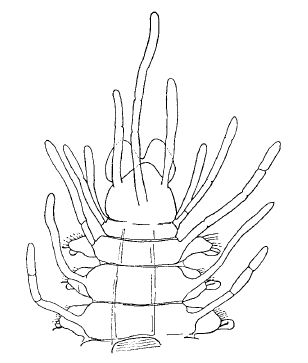
|
Heavy aciculae in setigers 2 to 5. |
 First four setigers with about 12 compound setae per parapodium. Shafts end in three knobs opposite to insertion of very short blades. |
 From 5th setiger onward, blades of most of these setae become longer. One or two setae in last setigers with large blades (ca. 35 µ).In 12th setiger shafts of all setae apparently end in one tip each, opposite insertion of blades. Blades bifid, some with spur below tips. |
|


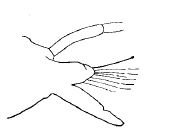
About half a dozen setae per parapodium in posterior region.
Diagnosis: A species of Streptosyllis Webster and Benedict with broad, anteriorly rounded palps, and heavy aciculae in setigers 2 to 5.
Differential Diagnosis: Six species of Streptosyllis are listed by Hartman (1959,1965): S. arenae Webster and Benedict; S. bidentata Southern, S. cryptopalpa Hartmann-Schröder; S. reducta Hartmann-Schröder; S. varians Webster and Benedict and S. websteri Southern. After inspecting the type of S. varians , Southern (1914) and Pettibone (1963) have pointed out that the animals described by Saint-Joseph(1895) under this name must be a different form; Southern observed the similarity with S. websteri . The new species is similar to S. arenae , S. cryptopalpa , and S.websteri , including the form described by Saint-Joseph(1895) as S. varians , in that it has heavy aciculae in setigers 2 to 5. It is well distinguished from these species, apart from details of setation, by its broad, rounded palps visible from above. S. varians likewise has large palps which, however, are pointed anteriorly; also, it has heavy aciculae in about 20 setigers. There are no palps and heavy aciculae in S. reducta . The latter species, as well as S. cryptopalpa , has a tooth in the pharynx which is not reported for the species described earlier.
Sources
Modified after Banse (1968), taxonomic remarks from Banse (1968)
Banse (1968)
Distribution
Ecology
intertidal sands
Add new comment